
by ALIAKSEI KAZHARSKI
The 2022 of Russia’s full-scale war of aggression launched some important critical epistemological debates (Hendl et al. 2024) on knowledge production in and on Central and Eastern Europe, conditions of applicability of certain established theories to the region, and the role of public commentary provided by globally established scholars and intellectual icons. Notably, while some of those grand theories seem internally coherent, practically speaking, some comments reveal a notable gap between them and region-specific area studies knowledge whose nuances are too easily ignored. In that respect, the problem with the theories turns out to be that while they look logically persuasive and their leading proponents sound rather authoritative at conferences and during numerous media appearances, their actual application can seem outright bizarre.
For example, imagine a scenario in which, following a US withdrawal from Europe, Germany seeks to acquire the bomb, while its neighbors, United Kingdom, France, and Russia, take joint military action against Germany to prevent it from going nuclear. While under the second Trump administration the limits of the thinkable with respect to the post-WWII Western security community have indeed been tested, to someone who is at least relatively acquainted with European politics, this still feels rather like a work of “alternative history” or science fiction. Yet, it is in fact a scenario to be found in the midst of a highly influential theoretical treatise published by a leading figure of American neorealism at the turn of the millennium.
Much has been written since the start of Russia’s full-scale invasion on the inadequacy of certain Western-centered epistemological positions for understanding Central and Eastern Europe, with realism taking many well-deserved hits (Makarychev and Nizhnikau 2023). However, the problem is not limited to the “positivist” theories with implicitly imperialist, “geopolitical” roots (Specter 2022). Regional perceptions of the conflict can also be shaped by different legacies and positionalities that vary across continents, while anti-Western sentiment combined with a general lack of knowledge and “epistemic injustice” can result in a “crooked mirrors” effect in local communication environments (Kazharski and Monsportová 2026). As Tereza Hendl sharply points out, it is not uncommon for critical and emancipatory, Marxist or post/decolonial thinkers, both in the West and beyond, to stubbornly cling to ideologized images of the Soviet Union as a supposedly anti-colonial power par excellence, while bluntly ignoring the history of East-Central European suffering under Russo-Soviet imperialism and colonization – or, otherwise, rationalizing oppression as a necessary local sacrifice to the overarching global cause of defeating everybody’s archenemy, Western imperialism (Hendl 2026).
Consequently, even if one repeatedly debunks the misconceptions of North American IR-realists or South American decolonial leftists, paradoxically, one finds oneself in the same position of being ignored on the empirical turf. No matter how many facts one presents and how many times and with how much detail one does so, the rationalizing narratives, which explain Russian imperial aggression away with “legitimate security concerns” or justify it as some sort of global “anti-colonial” struggle (Durdiyeva 2023), those narratives persist, seemingly immune to even the most horrendous kind of facts.
This does not have to be a pure coincidence, and the fallacies of the two approaches above, despite their irreconcilable conceptual differences, may ultimately stem from the same root. As I suggested in my scrutiny of the commentary on the Russo-Ukrainian war, rationalization, is in fact a way of exercising power and of disciplining that is done through prescription pretending to be detached analysis. Thus, a Foucauldian perspective would see realist reasoning as a technology of the (collective) Self (Kazharski 2024). Furthermore, as I also argued elsewhere, these power relations are not limited to academic or expert discourse: there are long-term synergies between realist or broadly understood “geopolitical” reasoning and populist right-wing politics with which it shares some inherent “grammar” (Kazharski 2025).
If such is the case, then facts and reasoning turn out to be a weaker antidote than one would initially expect. Though it may seem paradoxical, repeated intellectual attempts at an honest refutation can both consume the scarce resources at hand and, at the same time, actually strengthen and perpetuate the rationalizer-cum-justifier discourse, by providing additional fuel for the political economy of “clickbait” and fishing-for-citations behavior.
Is there then a better antidote? The author is uncertain here, but perhaps attempting to fix the existing imbalances and “blind spots” in knowledge production could help. Among other things, this means intervening in the existing patterns of the publishing industry, so as to cover those countries which are under-researched and underrepresented, to connect under-explored country-cases to the broader theoretical debates, and to give voice to those regional experts whose valuable expertise has so far not been so well plugged into the English-language academic and policy literature. This is what we have tried to do in our recently published Routledge Handbook of Contemporary Belarus (Kazharski 2026), in the sincere hope that more handbooks will follow soon, covering neighboring countries and shifting the typical focus somewhat from great powers to small and medium-sized states.
A related task would be developing the comparative and regional perspectives more deeply. The newly published edited volume Eastern Europe” and War. A New Kidnapping (Kazharski and Makarychev 2026) takes a step in that direction. Here we highlight the importance of moving away from homogenizing visions of Central and Eastern Europe, particularly typical for external, extra-regional gazes. We insist on capturing the region’s diversity, and the heterogenous and non-linear ways in which history and identities translate into different strategic cultures and (geo)political choices. Such an approach should help counterbalance the abstract positivism and pseudo-universalism of certain grand theories that tend to fail in understanding the region’s complexity, more often than not without properly trying to do so.
References
Durdiyeva, Selbi. 2023. “‘Not in Our Name:’ Why Russia is Not a Decolonial Ally or the Dark Side of Civilizational Communism and Imperialism.” The SAIS Review of International Affairs. May 29. Accessed April 14, 2026. https://saisreview.sais.jhu.edu/not-in-our-name-why-russia-is-not-a-decolonial-ally-or-the-dark-side-of-civilizational-communism-and-imperialism/.
Hendl, Tereza. 2026. “When Anti-Imperialism Becomes Selective with Tereza Hendl.” Yurt Jurt podcast. February 19. Accessed April 14, 2026. https://open.spotify.com/episode/6dmCAUvxxfVvmyCGruSfyJ.
Hendl, Tereza, Olga Burlyuk, Mila O’Sullivan, and Aizada Arystanbek. 2024. “(En)Countering Epistemic Imperialism: A Critique of ‘Westsplaining’ and Coloniality in Dominant Debates on Russia’s Invasion of Ukraine.” Contemporary Security Policy 45 (2): 171–209. doi:10.1080/13523260.2023.2288468.
Kazharski, Aliaksei. 2024. “On ‘Westsplaining,’ realism, and technologies of the Self: A Foucauldian reading of the realist commentary on Ukraine.” Journal of Regional Security 19 (1): 77–96. https://doi.org/10.5937/jrs19-48501.
Kazharski, Aliaksei. 2026. “On the nexūs Between Populism and Geopolitical rhetorics: Evidence from the Visegrád Four”. Intersections. East European Journal of Society and Politics 11 (3): 20–38. https://doi.org/10.17356/ieejsp.v11i3.1373.
Kazharski, Aliaksei, ed. 2026. Routledge Handbook of Contemporary Belarus. Routledge.
Kazharski, Aliaksei, and Andrey Makarychev 2026. “Eastern Europe” and War: A New Kidnapping? CEU Press.
Kazharski, Aliaksei, and Daniela Monsportová. 2026. “The Effects of Ukraine’s Communication Strategy in the Visegrad Four and the ‘Global South.’ Understanding the Target Audiences and Limits.” Journal of Contemporary Central and Eastern Europe 34 (1): 213–27. doi:10.1080/25739638.2025.2599336.
Makarychev, Andrey, and Ryhor Nizhnikau. 2023. Normalize and rationalize: Intellectuals of statecraft and Russia’s war in Ukraine. Journal of International Relations and Development 26: 632–642. https://doi.org/10.1057/s41268-023-00299-x.
Specter, Matthew. 2022. “Realism after Ukraine: A Critique of Geopolitical Reason from Monroe to Mearsheimer” Analyse & Kritik 44 (2): 243–267. https://doi.org/10.1515/auk-2022-2033.
Aliaksei Kazharski is an associate professor at Charles University, Faculty of Social Sciences, Institute of Political Studies.
@mysliar
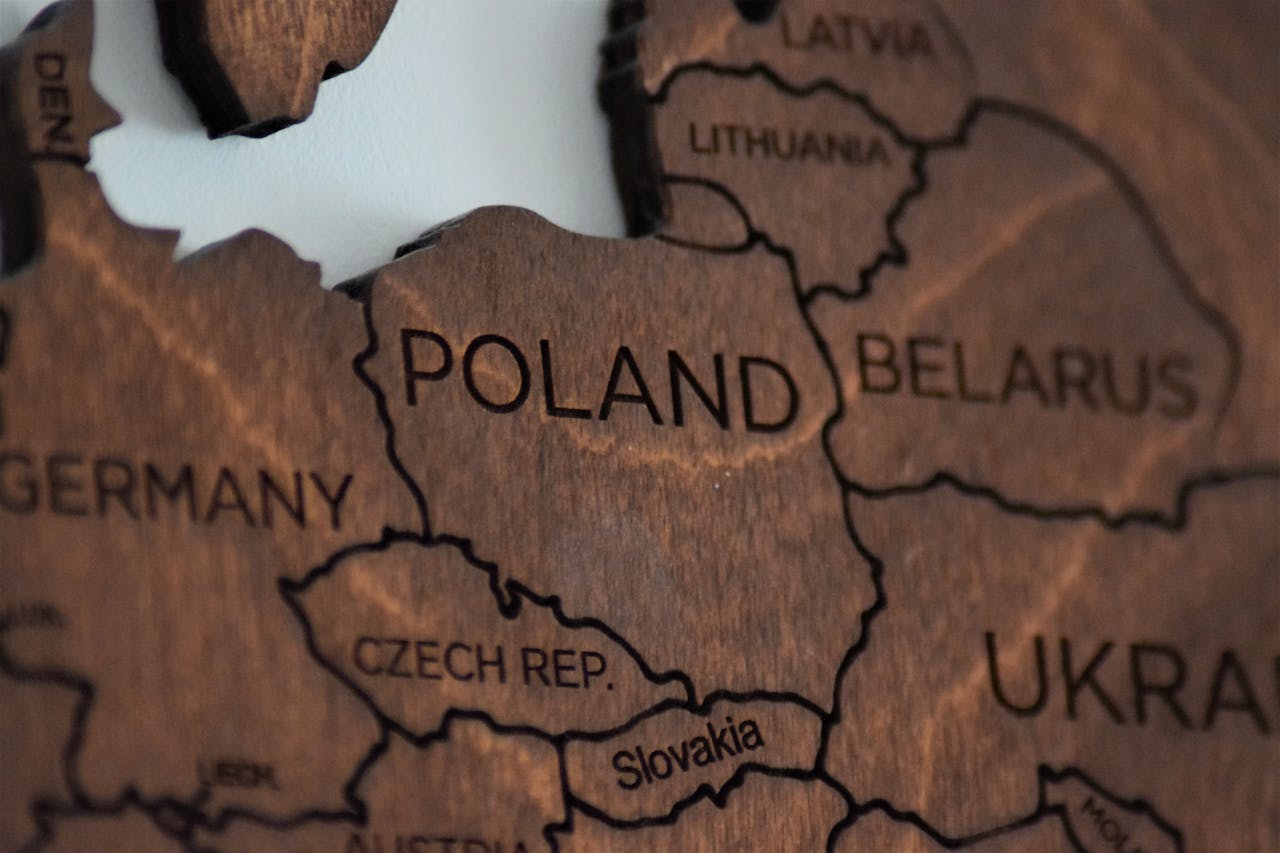
Cover image: Anthony Beck, Pexels