
by MILAN KRSTIĆ
Turbulence in relations between Serbia and Croatia peaked in March 2026. Photos of the Serbian Army’s MiG-29 fighter jets carrying Chinese supersonic rockets CM-400 and bombs LS-6, published first by aviation portal Tango Six, triggered a new series of sharp rhetorical reactions from the Croatian side, framing it as a potential threat to Croatia. On the other hand, Croatia’s signing of the Joint Declaration on Military Cooperation with Albania and authorities in Priština triggered a sharp reaction from the Serbian leadership, framing it as an anti-Serbian alliance that “violates the 1996 Subregional Arms Control Agreement”. These events revived a nearly decade-old discourse on the regional “arms race”, dating back to 2017/2018, in which Serbia and Croatia are presented as main competitors, each aiming for stronger military power relative to the other.
Around the same time, my article, titled “I Apologize, But Your Crime Is Worse Than Mine”: Relative De-Stigmatization in Serbian–Croatian Relations”, which examines one important aspect of Serbian-Croatian relations from about 15 years ago, was published in Global Studies Quarterly. I aimed to explain the puzzling practice of Serbia and Croatia simultaneously exchanging mutual apologies and accusations. My claim was that relative positioning within the international hierarchy of recognition was an important factor for both Serbia and Croatia, even during the period of progressing bilateral relations in 2010. Both countries were aiming not only to improve their absolute status and position in the international hierarchy by enhancing their reputations and reducing their own stigma stemming from the 1990s, but also to be relatively less stigmatised than their counterpart. Therefore, they were balancing their apologies with mutual accusations of past wrongdoing, which would prevent the other side from getting away without its share of responsibility.
This article shows that the relatively recent arms race was preceded by the mutual rhetorical “blame game” for the past. The relative distribution of arms was preceded by the relative distribution of stigma, a form of negative capital, which lowered the country’s standing in the regional and international hierarchy. The means of competition seem to be different nowadays, but the logic of relative gains is obviously older than the current arms races. This finding points to an important structural and cultural element: Serbia and Croatia never managed to consolidate a more friendly-based regional culture of anarchy since 2001, which would enable them to overcome the relative dimension and overcome their security dilemmas in mutual relations. I addressed this perception of mutual relations, which has never reached the level of friendship or the establishment of a real regional security community, in my recent book, titled Stigma, Fear and Foreign Policy: Serbia’s Destigmatization Dilemma in the Western Balkans, published by CEU Press.
However, while patterns of mutual competition are obviously older than the current arms race, it would be wrong to conclude that everything is the same as it was in mutual relations in 2010. Quite contrary – relations are much worse. There are two key indicators for this outcome. The first is that accusations were earlier pursued in parallel with apologies and compromising gestures. Over the last few years, compromising gestures in mutual relations have been absent, let alone apologies. The second is that the transformation from the political-discursive “blame-game” to the actual arms race represents a substantial qualitative change, although this arms race is in fact much less intensive than both sides tend to present it.
One of the reasons for such a change is at the level of decision-makers in both countries. It seems that political elites on both sides are using the presentation of the other as an enemy for their internal purposes of distracting attention from other domestic problems and for boosting populist nationalism in favor of their political option. However, while the character and ideologies of the governments in Belgrade and Zagreb explain part of the story, other factors (including structural ones) are often left out of the picture. A comprehensive analysis of all of them would require a much longer space and an adequate methodological and theoretical framework, but I will use this blog as a “food for thought” to outline some of them.
Incentives to play a role (or at least a mimicry) of a “good neighbor” in mutual relations (to get the recognition of the wider international audience as a properly behaving actor) have been substantially reduced in the third decade of the 21st century. With its recent accession to the Eurozone and the Schengen area, Croatia gained recognition as a member of the EU political “core”, leaving it with very little monitoring and almost no conditionality from the most influential actors in Europe. Serbian EU accession has been in a state of sclerosis since 2021, when the last negotiations cluster was opened. Given the lack of willingness to pursue key reforms in other areas (especially in democracy and the rule of law), it seems that making any compromising gestures towards Croatia would offer no particular benefit to this process. Therefore, it could be argued that the logic of consequences has changed in the meantime due to various internal and external events.
However, the logic of appropriateness has also been changed in the meantime. The desire to be recognised as a “normal” or “equal” actor and to act properly becomes a blurrier task in times when international norms are constantly challenged, and the order seems in turmoil. I wrote four years ago that the conceptual relationship between de-stigmatization and Europeanization, which had earlier been considered synonyms in the European context, is becoming increasingly decoupled. With the recent substantial challenges to the world order, which have led many Western politicians to state that the rule-based liberal international order is falling apart, a spillover of transgressive behaviour at the regional level seems even more possible and realistic than before.
However, the perspective of relations is not necessarily dark. There is plenty of space for substantial improvement in both mutual relations between Serbia and Croatia and regional cooperation in the Western Balkans. Strong economic and people-to-people ties are strengthening the connections between countries, in whose mutual interest it would be to deepen the political cooperation as well. In some of the next blogs, I will outline possible solutions for returning to a positive track in mutual relations.
Milan Krstić is an Associate Professor at the University of Belgrade – Faculty of Political Science. Email: milan.krstic@fpn.bg.ac.rs
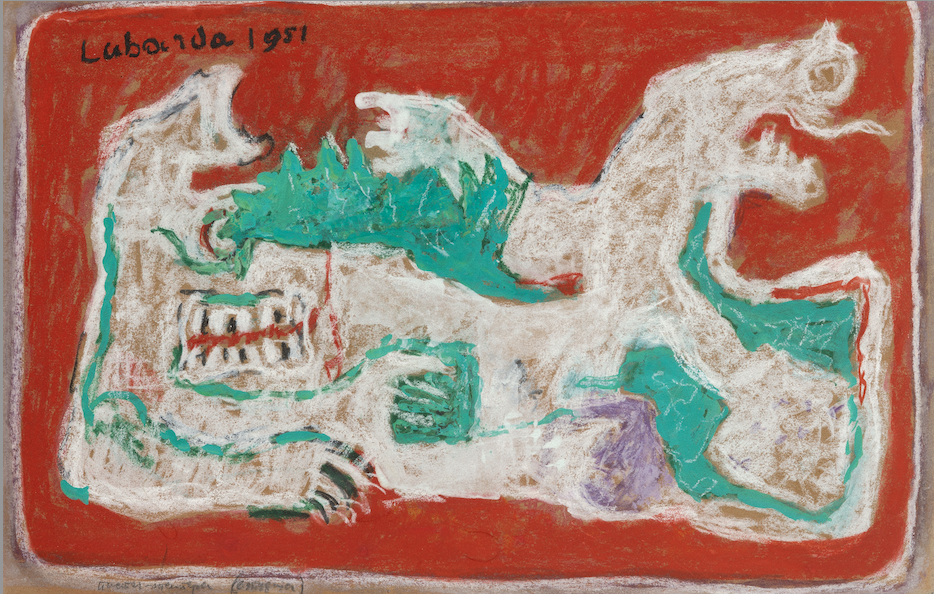
Cover illustration: Petar Lubarda (1907–1974), Kleveta (eng. Slander), 1951 © Kuća legata, Belgrade, Republic of Serbia. The right to use the image for the book cover has been kindly granted to the author by the Kuća legata.