
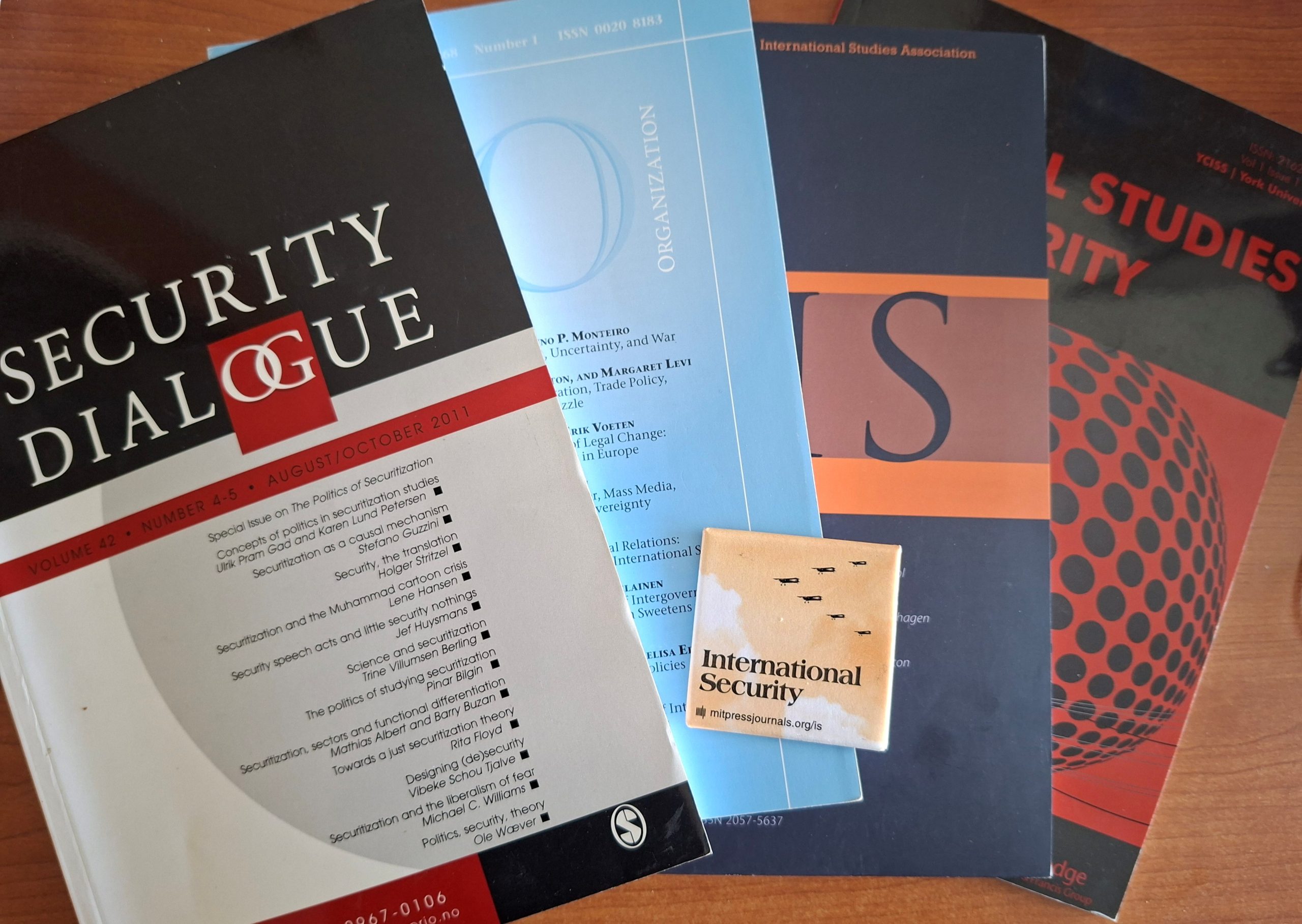
Whether you are an experienced scholar, an early career researcher, or just going through your BA studies, it is expected that you follow the state of the art and key debates that shape our academic disciplines. These are some of the academic journals that stand out in the study of international security for their rankings, impact, scholarly rigor, theoretical sophistication, in-depth analytical work, or for fostering innovative approaches. The list is not exhaustive and is not made in a particular order, but it tries to offer a selection of journals that have impacted academic debates for decades, as well as those outlets that seem to move the field in new exciting directions. We provide below the titles and brief descriptions of these journals as presented on their respective websites.
„International Security, the #1 journal in International Relations based on 2024 impact factor, publishes lucid, well-documented essays on the full range of contemporary security issues. Its articles address traditional topics of war and peace, as well as more recent dimensions of security, including environmental, demographic, and humanitarian issues, transnational networks, and emerging technologies.
International Security has defined the debate on US national security policy and set the agenda for scholarship on international security affairs for more than forty years. The journal values scholarship that challenges the conventional wisdom, examines policy, engages theory, illuminates history, and discovers new trends.
International Security is published by the MIT Press, and sponsored and edited by the Belfer Center for Science and International Affairs, Harvard University.“
„One of the oldest peer-reviewed journals in international conflict and security, Contemporary Security Policy promotes theoretically-based research on policy problems of armed conflict, intervention and conflict resolution. Since it first appeared in 1980, CSP has established its unique place as a meeting ground for research at the nexus of theory and policy.
Spanning the gap between academic and policy approaches, CSP offers policy analysts a place to pursue fundamental issues, and academic writers a venue for addressing policy. Major fields of concern include:
- War and armed conflict
- Peacekeeping
- Conflict resolution
- Arms control and disarmament
- Defense policy
- Strategic culture
- International institutions.
CSP is committed to a broad range of intellectual perspectives. Articles promote new analytical approaches, iconoclastic interpretations and previously overlooked perspectives. Its pages encourage novel contributions and outlooks, not particular methodologies or policy goals. Its geographical scope is worldwide and includes security challenges in Europe, Africa, the Middle-East and Asia. Authors are encouraged to examine established priorities in innovative ways and to apply traditional methods to new problems.”
European Journal of International Security
“The European Journal of International Security (EJIS) publishes theoretical, methodological and empirical papers at the cutting-edge of security research. Welcoming high quality research from around the world, EJIS covers all areas of international security, including: conflict and peacebuilding; strategy and warfare; environmental, health and food security; energy, ecological and climate security; human, gender and everyday security; technology and security; and security governance. The journal is particularly concerned to make connections and build bridges, both between different disciplinary and theoretical perspectives, but also across regional boundaries. EJIS publishes rigorous, peer-reviewed papers that significantly advance scholarship through original analysis of a salient policy issue, the exploitation of new data, and/or the innovative development and application of theory.”
“Security Studies publishes leading scholarship in the field of international security, broadly construed. The journal is wedded to no particular theoretical paradigm, epistemological stance, or methodological approach. Security Studies embraces the field in all its intellectual diversity, welcoming contributions to scholarly knowledge from the plural communities and research traditions that constitute the field. Its articles provide an answer to an explanatory puzzle, present original empirical research (using a range of methods), critically engage core theoretical concepts, or otherwise intervene in disciplinary debates. Security Studies articles’ analysis is rigorous in terms appropriate to their methodological approach.
Security Studies welcomes scholars from all disciplines, and its articles do not conform to narrow disciplinary norms. However, authors might find it helpful to understand what Security Studies is not . Although Security Studies articles are often motivated by policy questions and often have policy implications – and Security Studies encourages authors to spell those out – Security Studies is not a policy journal; its articles are directed primarily toward generating scholarly knowledge, rather than arguing for a particular policy. Similarly, although Security Studies has traditionally been, and remains, sympathetic to careful and deep historical research, it is not a history journal; Security Studies articles engage with historical materials to answer analytical questions and address analytically-framed debates. Articles that are purely descriptive – for instance, of a particular region’s contemporary or past security challenges, of a government’s decision-making process, of a historical case – will not pass muster. Articles published in Security Studies will be explicit about their central analytical pivot and be framed around those analytical questions and contributions.”
“Security Dialogue is a fully peer-reviewed and highly ranked international bi-monthly journal that seeks to combine contemporary theoretical analysis with challenges to public policy across a wide ranging field of security studies. This journal is a member of the Committee on Publication Ethics (COPE).
Security Dialogue seeks to revisit and recast the concept of security through new approaches and methodologies. It encourages ground-breaking reflection on new and traditional security issues such as globalization, nationalism, ethnic conflict and civil war, information technology, biological and chemical warfare, resource conflicts, pandemics, global terrorism, non-state actors and environmental and human security.
Security Dialogue promotes analysis of the normative dimensions of security, theoretical and practical aspects of identity and identity-based conflict, gender aspects of security and critical security studies.”
“European Security is a forum for discussing challenges and approaches to security within the region as well as for Europe in a global context. The journal seeks to publish critical analyses of policies and developments in European institutions and member states, their relations with European and other immediate neighbours, and their relations with the wider world, including other regional and international organisations. It is also interested in non-European perspectives on Europe in a global context.
Whilst the journal is particularly interested in stimulating debate between varied theoretical approaches, it strongly encourages policy debates on topical issues that combine conceptual and empirical analyses. Within this broad framework the journal invites submissions in the following areas:
- Theoretical and methodological approaches to the study of security in Europe
- Comparative and in-depth studies of European states and national defence policies
- European organisations as security providers
- Conflict prevention, peacekeeping, conflict resolution, and crisis management as reactions to regional insecurity
- Security and geo-politics of Europe and the wider world”
Journal of Global Security Studies
“The Journal of Global Security Studies (JoGSS) aims to publish cutting-edge research which offers a significant, rigorous and original contribution to our understanding of global security and global aspects of debates in security studies. The journal welcomes a variety of methodological, epistemological, theoretical, normative, and empirical approaches to the study of traditional and non-traditional security issues. JoGSS is particularly committed to encouraging dialogue, engagement, and conversation between different parts of the field and across regional boundaries. Due to the volume of submissions we receive, articles that do not make clear how their research links with debates in security studies, or global security issues, will not be considered.”
“Armed Forces & Society is the leading peer-reviewed, interdisciplinary, and international journal publishing on topics such as
- Civil Military Relations
- Military Organizations
- Use of Force
- Conflict Resolution
- Logic and Consequences of War
- Terrorism
- Military Leadership & Professionalism
- Ethics
- Security
- Arms Control
- Peacekeeping
- Defense Economics
- Recruitment and Retention
- Reserve Forces and Veterans
- Representation Issues
- Family and Health Issues
- Military History
Armed Forces & Society publishes empirical, theoretically-informed articles, research notes, book reviews, and review essays. Its articles may adopt an interdisciplinary, comparative, or historical perspective, use qualitative or quantitative methods, and range from policy-relevant to theoretical themes—but they always meet the highest standards of intellectual rigor, scholarly argument, evidence, and readability.”
“Security has long shaped social relations across a range of spaces, places and scales across the world. Security is often represented as an inherent human need, a value, a virtue or social good, as a commodity to be bought, sold and exchanged and as a modality of governing to regulate and optimize life. But security is also the banner under which forms of repression, dispossession and pacification take place, offering them a guise of legitimacy. Critical Studies on Security is an international, peer-reviewed journal dedicated to the study of ‘security’ in and through social critique. The journal aims to publish theoretically informed scholarship, which engages with the practice and politics of security from diverse situated contexts, histories and experiences. We welcome articles from fields and disciplines across the social sciences and humanities, and from any critical social theoretical position.
Critical Studies on Security has two sections: full length peer-reviewed research articles (described above) and Interventions articles. Interventions is a special section of Critical Studies on Security that curates collections of short, experimental, and multi-form contributions gathered around a shared theme. Contributions might take the form of fragments, vignettes, essays, interviews, poems, literary pieces, images, dialogues, or other formats that invite critical, creative, and unconventional engagements with questions of security and insecurity […]”
“Journal of Cybersecurity publishes accessible articles describing original research in the inherently interdisciplinary cyber domain. Journal of Cybersecurity is premised on the belief that computer science-based approaches, while necessary, are not sufficient to tackle cybersecurity challenges. Instead, scholarly contributions from a range of disciplines are needed to understand the varied aspects of cybersecurity.
Journal of Cybersecurity provides a hub around which the interdisciplinary cybersecurity community can form. The journal is committed to providing quality empirical research, as well as scholarship, that is grounded in real-world implications and solutions.
Journal of Cybersecurity solicits articles adhering to the following, broadly constructed and interpreted, aspects of cybersecurity:
- anthropological and cultural studies;
- security and crime science;
- security economics;
- logical, methodological, and philosophical aspects of information security;
- security modelling;
- human factors and psychology;
- legal aspects of information security;
- political and policy perspectives;
- strategy and international relations;
- and privacy.”
Photo credit: CIS-FPN photo archive