
by MILAN VARDA
Not all the best war games look like war games. Some are about ruling empires, but others are about surviving a siege, checking passports, or navigating a collapsing kingdom. Together, they illuminate different dimensions of international security and can thus be a helpful learning tool for international security. Games are powerful teaching tools in classrooms, offering students numerous advantages compared with more traditional teaching methods, all while being more interesting. Games can be stronger tools for teaching than traditional methods due to enhancing student engagement, information retention and their ability to comprehend abstract theoretical concepts. That is also true for the field of international security, where games like RAND’s Hedgemony can be used to teach numerous concepts and theories. Video games have similar potential.
There are many games that more or less explicitly deal with issues of international security. Some of them are especially focused on international security, acting almost like simulators and approaching serious games in their depth, scope and complexity. Others are focusing on some entirely different topics, but they incorporate and reflect important dynamics of international security from an unexpected perspective. This list is not ranking games just based on which ones best emulate the real international world or strategic interaction. Rather, it presents games that show at least some of the international security dynamics really well, whether or not they are political games per se. It will show six games in total. Three games that are unsurprising to be found on such a list. Three others are surprising entries that were not inspired by any international security-adjacent phenomena, but that incorporate the dynamics really well. This list reflects, in no particular order, recommendations based on the writer’s substantial albeit limited playing experience.
UNSURPRISINGLY GOOD: Paradox games
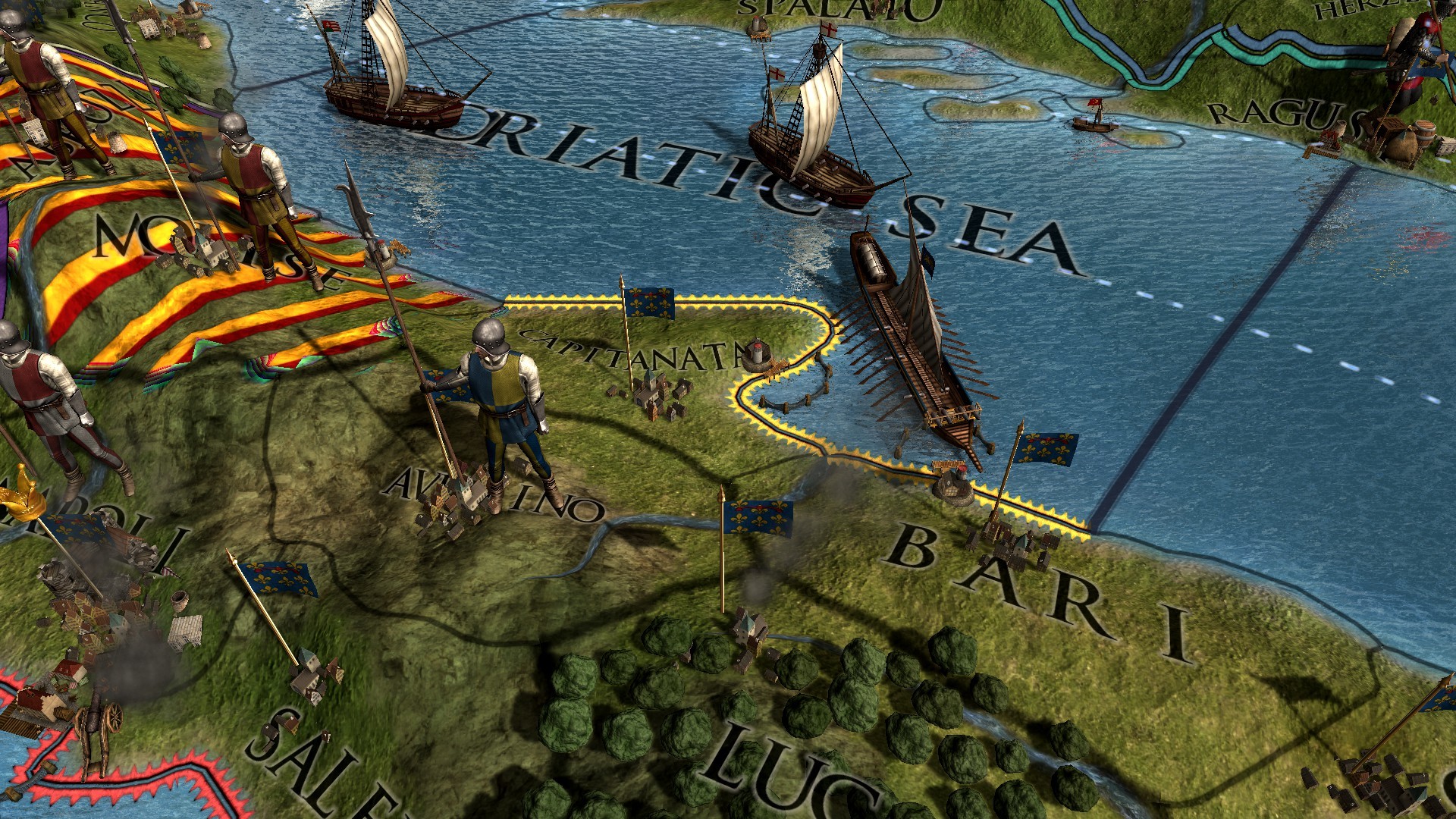
Of course, this has to be there. Paradox games are complex, multilayered grandstrategic video games. It would, however, be very unfair to place only one of their games here. Not only because they are so similar in scope and depth that favouriting one would be unjust, but also because I have not truly played them. Now, hear me out. I am learning how to play Europa Universalis IV now, and I have played it a bit, but I still lack the ability to conduct actions that I want to, largely due to the complexity of the game mechanics. Regardless, games like Europa Universalis and Crusader Kings offer a plethora of international security interactions, ranging from diplomatic and economic relations, cultural effects on policy, and straight-up war and conquest. In general, its complexity approaches that of a true, rigid, serious game, except that it uses a computer as the adjudicator.
SURPRISINGLY GOOD: The Witcher 3
Hold your horses! I mean, Roach! Roaches? This may be the single best video game of all time, but why is it here? Well, this fantasy role-playing game, based on the novels of the same name and rooted in Slavic mythos, has a surprisingly interesting political landscape. While it is a third-person action RPG, Geralt of Rivia pursues the mission of saving his daughter in a complex political setting. An empire and a dying kingdom in a clash, with numerous bandits, supernatural phenomena, and even otherworldly Wild Hunt proliferating and using the power vacuum for their own agendas. The game shows the consequences of war, great power rivalry, and political instability. Geralt is not only embedded in the crisis political context, but is also the main actor of many of the events, including the assassination of the king. His choices, ultimately, shape the world. Depending upon them, we may have a new balance of power with a resurgent kingdom in a stable bipolar system (at the cost of the lives of friends) or the immediate peace at the cost of having only one empire ruling over everything (and the cost of someone who is not as much of a friend). Dilemmas like this show not only the significance of individual agency, but also choices between different world orders, between negative peace and continued war, between counterbalancing and bandwagoning.
UNSURPRISINGLY GOOD: Rise of Nations
Now, this one is a classic. The golden age of Microsoft Games is long gone now, but in its prime, it made many excellent real-time strategy games, like Rise of Nations, Age of Empires and Age of Mythology. While incomparable to more complex modern games, this quarter-century-old game has a degree of focus on contemporary warfare, diplomacy, resources and even governmental systems. Being a republic and a monarchy is not the same, and neither is opting for capitalism against communism. Likewise, being able to sue for peace and declare war made it different compared with real-time strategy games of its age. The diversity of resources made the players constantly fight over them while aiming for dominance.
SURPRISINGLY GOOD: Kingdom Come: Deliverance
Kingdom Come: Deliverance games are widely praised for their immense historical accuracy. Both KCD1 and KCD2 are first-person, highly realistic role-playing games set in high medieval Bohemia, in the period after the death of Charles IV, Holy Roman Emperor. In a world where the Bohemian King Wenceslas and the Hungarian King Sigismund fight for supremacy, Henry, a young son of a blacksmith, has to deal with issues of his own. His entire hometown is invaded, pillaged, and he loses most of his friends and family. Navigating the world with limited skills, he has to learn and make connections in order to make it in a society with exceptionally rigid social stratification. The war between kings has brought destruction and bandits that commoners need to deal with. Nobles, meanwhile, are having their own struggles for power, drawing Henry into them. While his agency is more limited compared to Geralt’s, this commoner is, much like medieval Forest Gump, travelling through the world of major political upheavals. Religion, legitimacy and power intersect and shape the world around him. Henry has to navigate the world of chaos, negotiating between numerous nobles and aiding them in their intrigues. While the player does not control events on a grander scale, this game shows how rigid social structure, a highly religious society and war affect the common folk.
UNSURPRISINGLY GOOD: This War of Mine
This War of Mine might be the most direct and emotionally powerful game on this list. Unlike most war games, you do not play as a soldier. You play as civilians trying to survive in a besieged city. Even after just a short time with the game, one thing becomes clear: war is not strategy, it is suffering. You scavenge for food, avoid snipers, manage illness, and make impossible moral choices. Do you steal from others to survive? Do you risk your life to help someone else? The game strips away the abstraction that often defines discussions of war in IR, leading with issues of the everyday war/peace nexus. What makes this particularly powerful is that it humanises conflict. It forces players to confront the civilian experience of war.
SURPRISINGLY GOOD: Papers, Please
What is a game about checking documents at a border checkpoint doing here? The graphic sucks, and the player is just checking documents. Well, this game may not be impressive visually (though I find it highly aesthetic given its content), not in terms of sheer gameplay, but it offers much more. Set in a fictional totalitarian state, the player barely earns a living while taking care of the family. It showcases the difficulty that people are facing in totalitarian regimes. This is especially true of border agents, who, in some cases, like this, engage in institutionalised racial/ethnic profiling, all while being tempted by bribes and ethical reasons. In addition, both the regime terror and terrorist groups interact with the player. He has to make many choices in this dilemma game, leading to numerous possible endings, having differing implications for both the player, the terrorist and the ruling regime.
Video games can reflect international security dynamics truly well, and they can be a teaching tool. They are not replacements for theory or empirical analysis. But they are powerful complements. They allow us to experience trade-offs rather than just describe them and to engage emotionally with abstract concepts. In short, they turn international security from something we read about into something we experience.
Not all games need to be explicitly political to teach us about politics. Sometimes, the most insightful lessons come from unexpected places: a fantasy world, a medieval village, or a border checkpoint. Because at their core, international relations are not just about states and systems. They are about choices. And games, good games, are nothing if not systems of choice.
References
Boyer, Mark A., Mary Caprioli, Robert A. Denemark, Elizabeth C. Hanson, and Steven L. Lamy. 2000. “Visions of International Studies in a New Millennium.” International Studies Perspectives 1 (1): 1–9.
Ejdus, Filip, Đorđe Krivokapić, Rastko Popović, Marko Kovačević, Milan Varda and Aleksandra Ilić-Rajković. 2026. “From Pentagon to Classroom: RAND’s Hedgemony as a Pedagogical Tool in Graduate IR and Security Studies“. Journal of Political Science Education 1-18.
Loggins, Julie A. 2009. “Simulating the Foreign Policy Decision-Making Process in the Undergraduate Classroom.” PS: Political Science & Politics 42 (2): 401–407.
McCarthy, Mary M. 2014. “The Role of Games and Simulations to Teach Abstract Concepts of Anarchy, Cooperation, and Conflict in World Politics.” Journal of Political Science Education 10 (4): 400–413.
Milan Varda is a Research Assistant and PhD Candidate at the University of Belgrade – Faculty of Political Science. He is also a member of the Serious Game Lab at the Centre for International Security.
Cover image credit: Benchmark.rs