
by SABINA SALI
The Western Balkans remains a region in which security is deeply interdependent. Geographic proximity, unresolved historical disputes, and overlapping ethnic and political cleavages mean that military developments in one state are rarely perceived in isolation by its neighbours. At the same time, they remain sufficiently divided over Euro-Atlantic integration to prevent any stable regional order from fully taking hold. Croatia is embedded within both NATO and the EU, while Albania and Montenegro are NATO members. Serbia, by contrast, maintains a formal policy of military neutrality, even as Kosovo’s statehood remains unrecognised by Belgrade and several other states. Bosnia and Herzegovina, meanwhile, continues to operate within a constitutional framework that is itself a product of war. Thirty years after Dayton, this structural asymmetry is no longer a transitional phase but has become a permanent condition.
In such a compressed regional space, any military move by one actor inevitably assumes security significance for all others, as the developments between March 2025 and March 2026 clearly demonstrate. Within that period, the region witnessed the signing of the trilateral Declaration on Military Cooperation between Albania, Croatia and Kosovo in Tirana which was followed by signing of the Agreement on Strategic Cooperation in the Field of Defence between Serbia and Hungary in Belgrade, the completion of deliveries of twelve Rafale fighter jets to Croatia, the signing of a €2.7 billion contract under which Serbia will receive twelve Rafales of its own from France and, most recently, the public confirmation that Serbia has acquired Chinese CM-400 supersonic air-to-surface missiles with a range of up to 400 kilometres. All of this is unfolding in the year that the Agreement on Sub-Regional Arms Control, signed in Florence on 14 June 1996 under OSCE as one of the pillars of the post-Dayton peace architecture, marks its thirtieth anniversary, and the region it was designed to regulate looks fundamentally different from the one its signatories had in mind.
The Tirana Declaration: Consolidating the Atlantic Bloc
Given the existing divisions over NATO integration in the Western Balkans, the Declaration on Military Cooperation signed in Tirana in March 2025 was less of a surprise and more of a formalisation of dynamics that were already happening. Croatia, a NATO and EU member, Albania, a NATO member, and Kosovo, aspiring to join both, are the three parties that signed a trilateral defence framework structured around four pillars: developing defence capabilities and industrial cooperation, increasing military interoperability through joint training and exercises, countering hybrid threats through shared intelligence, and supporting Kosovo’s integration into Euro-Atlantic security structures. At the time of signing, Bulgaria was also identified as a potential fourth party.
The legal nature of the document matters because the Tirana Declaration is a non-binding political instrument, not a treaty and not a formal alliance. As Nikola Lunić of the Belgrade-based Council for Strategic Policy noted, any operational consequences would still require NATO and OSCE approval. Serbia’s President Vučić publicly argued that the declaration violated the 1996 Florence Agreement, an accord limiting the signatories’ (Serbia, Croatia, Bosnia and Herzegovina, Montenegro) holdings of tanks, armoured vehicles, artillery, combat aircraft and attack helicopters. The claim is legally precarious, Kosovo was never a signatory, and a non-binding declaration cannot override treaty obligations, but the underlying tension is real. Coordinated rearmament between parties in unequal legal standing toward the agreement does, at minimum, expose the limits of a framework designed for a region that no longer exists in the form it assumed.
The declaration’s practical implications are already becoming visible. By early 2026, the three countries had begun practical cooperation in training, academic exchange, and defence production. Kosovo’s acting Defence Minister announced a principal-level agreement on the joint development of the “Shota” MRAP, an armoured vehicle designed by Albanian company Timak. No formal contract has been signed yet, and no production timeline has been confirmed. But for a Kosovo Security Force targeting full army status by 2028, the prospect of co-producing armoured vehicles with NATO partners represents a qualitative shift.
Belgrade Responds: The Serbia-Hungary Agreement
Two weeks after the Tirana Declaration, Belgrade had its answer. On 1 April 2025, Serbian Defence Minister Bratislav Gašić and his Hungarian counterpart Kristóf Szalay-Bobrovniczky signed, in the presence of President Vučić, a plan operationalising the defence cooperation framework the two countries had established in 2023. The document outlines 79 joint programmes for 2025, which include helicopter exercises, flotilla training, marksmanship drills, and cybersecurity collaboration. While Vučić used the occasion to invoke the prospect of a future “military alliance or union” between the two parties, the document itself is, in substance, a standard cooperation plan that merely operationalises commitments already agreed in 2023.
That gap between the rhetoric and the reality is the most revealing thing about this agreement. Hungary is a NATO and EU member, which means that whatever Budapest can offer Belgrade in defence terms is structurally bound by its Alliance obligations, which means it cannot commit to anything that would conflict with Article 5. The partnership is real in its bilateral dimensions, where Hungary has been buying ammunition from Serbia while Belgrade acquired 26 Hungarian BTR-80A armoured personnel carriers in early 2024. But there is only so far this partnership can go. The elevated ceremony and Vučić’s rhetoric about future military unions signalled less strategic depth than strategic messaging, directed at an audience other than Brussels or Washington.
The Arms Race
The diplomatic dimension of Belgrade’s response to shifting regional alignments is written in procurement and that picture is considerably more complex than the headline Rafale deal suggests. Croatia completed its Rafale acquisition in April 2025, when the twelfth and final aircraft landed at Zagreb-Pleso, completing a deal signed with France in November 2021. All twelve jets are in the F3-R standard and equipped with the MBDA Meteor beyond-visual-range air-to-air missile. Since January 2026, Croatia assumed full responsibility for monitoring and protecting its national airspace within NATO’s Integrated Air and Missile Defence framework. Serbia’s own Rafale contract, signed in August 2024 in the presence of President Macron, covers twelve jets in the more advanced F4.1 configuration, at a cost of €2.7 billion, with delivery scheduled by 2029. The asymmetry, however, is intentional as Serbia’s Rafales are expected to rely on the shorter-range MBDA MICA rather than the Meteor, underscoring France’s calibrated approach to technology transfer vis-à-vis a non-NATO state. The platform is the same, but the strategic context is fundamentally different.
More revealing than the Rafale comparison are the SIPRI data on Serbian arms imports, where in the 2021-2025 period, China accounted for 61% of deliveries, Russia for 7%, and France for 12%. The Rafale deal, framed by both Belgrade and Paris as a strategic reorientation westward, is, in quantitative terms, a marginal correction to a procurement portfolio dominated by Chinese and Russian systems, where among them are the Chinese FK-3 surface-to-air missile system, the Russian Pantsir-S1, and Chinese CH-92A and CH-95 drones. The result is a hybrid arsenal in which Western and Eastern systems operate side by side as a combination that has raised concerns in Washington and among NATO analysts about potential intelligence exposure, given that non-NATO-standard systems are being integrated alongside Western sensors within the same national command architecture.
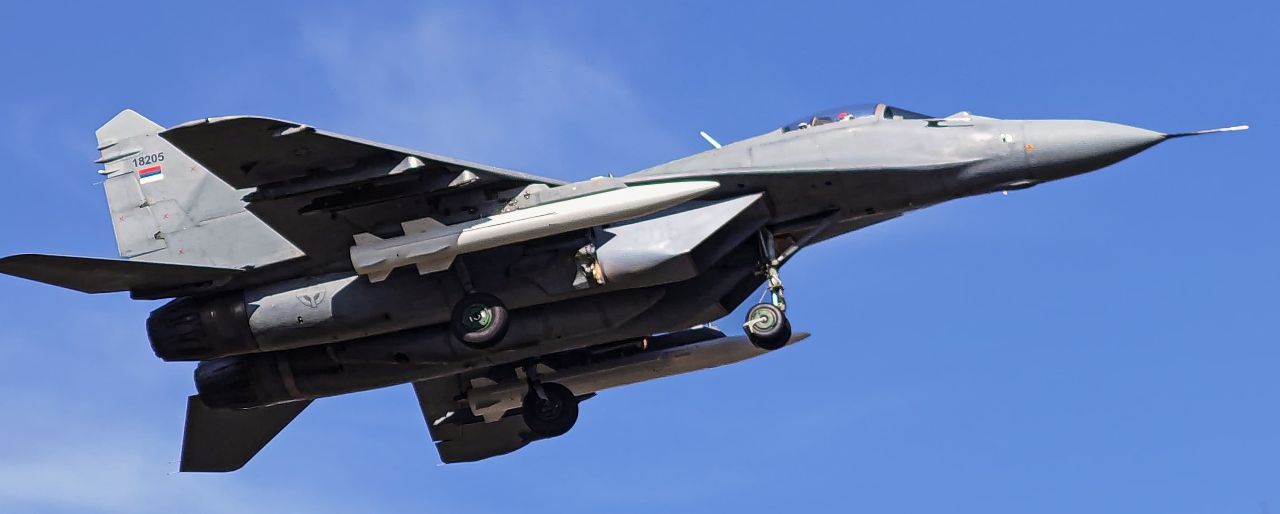
Then came March 2026, when photographs surfaced on social media showing Serbian MiG-29s carrying Chinese CM-400AKG supersonic air-to-surface missiles alongside the LS-6 precision-guided bomb. Days later, Vučić publicly confirmed the acquisition, stating that Serbia possessed “a significant number” of the missiles and would acquire more, adding, with characteristic flair, that it had received “a slight discount.” Croatian Prime Minister Plenković announced that Zagreb would notify NATO allies. Vučić, in turn, stated that Serbia was “preparing to be attacked” by the alliance forming between Pristina, Tirana and Zagreb.
What makes this procurement genuinely consequential is the geometry. A supersonic missile with a claimed range of up to 400 kilometres launched from Serbian airspace, could in principle reach Zagreb, Tirana and Pristina without a single aircraft crossing any international border. The integration of Chinese guidance systems onto Russian airframes represents a multi-vector capability that NATO planners cannot easily categorise within existing threat assessment frameworks. None of this implies Serbia is planning an attack; the acquisition fits a consistent pattern of signalling capability rather than intent. But the capability exists, and crucially, it does not violate a single provision of the Florence Agreement.
The Florence Agreement at Thirty: A Framework the Region Has Outgrown
The Agreement on Sub-Regional Arms Control, signed in Florence on 14 June 1996, turns thirty this year. Its five categories of regulated weapons: battle tanks, armoured combat vehicles, artillery, combat aircraft and attack helicopters, remain subject to numerical ceilings that no signatory has formally breached. In that narrow technical sense, the agreement is functioning.
However, the weapons driving the current cycle of regional tension, supersonic air-to-surface missiles, loitering munitions, unmanned systems, and anti-access platforms, fall entirely outside its text. As Carlo Trezza of the NATO Defence College Foundation has argued, the framework urgently needs modernisation, a proposal that has gained no political traction, and which the current climate of mini-alliances and competitive procurement has made simultaneously more necessary and less achievable. At thirty, the Florence Agreement is not broken; it is simply no longer adequate for the region it was designed to govern. Moreover, perhaps even more important than its inability to capture the qualitative dimensions of the regional arms race, in addition to its quantitative aspects, is the fact that the framework has clearly not been effective enough in fostering regional trust, which has been increasingly eroded.
Sabina Sali is an MA student in Contemporary Balkan Studies at the University of Belgrade, Faculty of Political Science, and RSKH intern at the Centre for International Security.